
Employment-based green card lawyers coordinate the legal strategy connecting temporary work status, employer sponsorship, professional evidence, immigrant petitions, visa availability, and the final permanent-residence stage. For H-1B professionals, employers, researchers, engineers, founders, and other high-skilled talent, the central question is not simply which form to file—it is which pathway fits the facts, who controls each step, and how the plan changes if the job, employer, evidence, or visa bulletin changes.
At NYIS Law Firm, our employment immigration team helps clients evaluate employer-sponsored PERM and EB-2/EB-3 pathways, evidence-driven options such as NIW and EB-1, H-1B and other work-visa continuity, Form I-140 strategy, and I-485 or consular-processing timing. We work with both employers and employees, provide Chinese-English communication, and review each route against the applicant’s qualifications, the employer’s role, family needs, and current immigration history.
| At a glance: An H-1B professional may need status and green-card planning on one timeline; an employer needs compliant sponsorship and document coordination; high-skilled talent may need a structured NIW or EB-1 evidence strategy. We help clients evaluate these related workstreams, but no category or result is guaranteed and every route depends on its own legal standard and facts. |
We help professionals and employers coordinate employment-based green card pathways with work-status, evidence, and timing considerations.
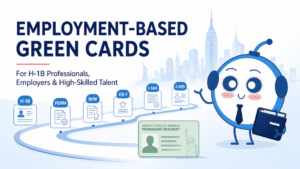
What Employment-Based Green Card Counsel Actually Coordinates
An employment-based green card case can involve more than one agency and more than one decision-maker. The employer may control sponsorship, job requirements, wage information, recruitment, and company evidence. The foreign national may control education records, immigration history, professional achievements, recommendation evidence, family information, and travel decisions. Counsel must connect these inputs to the correct legal route and sequence.
| Client or stakeholder | Common questions | Possible pathways | Legal work that may matter |
| H-1B professional | Will the employer sponsor? How much H-1B time remains? What happens after a transfer or layoff? | PERM EB-2/EB-3, NIW, EB-1A, adjustment or consular processing | Status history, employer coordination, Priority Date, I-140, I-485, travel and dependent planning |
| U.S. employer | Is the role eligible and sustainable? Who owns recruitment and compliance records? | PERM, EB-2/EB-3, EB-1B, EB-1C and related work-visa planning | Position requirements, prevailing wage, recruitment, ability to pay, corporate records and policy consistency |
| High-skilled talent | Does the evidence support a self-petition or higher-preference case? | NIW, EB-1A and, where applicable, employer-supported EB-1B or EB-1C | Proposed endeavor, achievements, impact evidence, expert letters, RFE strategy and long-term status planning |
The route should be selected before the drafting becomes form-driven. A strong legal team should be able to say what must be proved, which party supplies the evidence, which assumptions remain uncertain, and what events would require the plan to be reassessed.
Employer-Sponsored Green Cards: PERM, EB-2 and EB-3
For many H-1B workers, the employment-based green card process begins with an employer-sponsored PERM case. The U.S. Department of Labor’s permanent labor certification overview explains that the employer—not the employee—is responsible for the filing. DOL generally evaluates whether qualified U.S. workers are available for the offered position and whether employing the foreign worker would adversely affect similarly employed U.S. workers.
The legal work can include defining the offered position and minimum requirements, requesting a prevailing wage determination, planning and documenting recruitment, preparing Form ETA-9089, maintaining an audit file, and coordinating the later Form I-140 petition. Once DOL certifies a PERM application, the certification generally must be submitted to USCIS with Form I-140 within its 180-day validity period.
The employer’s ability to pay the offered wage can also matter at the I-140 stage. The evidence may look different for a startup, a small private business, a large corporation, or a public university. Employment-based counsel should understand both the immigration standard and the financial or institutional records available to that employer.
Our case experience: small employer and PERM audit
In one de-identified EB-3 matter, we represented an H-1B professional with less than approximately 18 months of H-1B time remaining and an employer with fewer than 10 employees. When the PERM case was audited, we had already prepared the recruitment record and audit file. We submitted the compliance documentation, and the PERM was approved five days after the audit response. The premium-processing I-140 was later approved in May 2026.
This example shows why small-employer sponsorship requires early financial and compliance planning. It does not establish a standard processing time or predict another employer’s audit or approval outcome. Read the de-identified NYIS EB-3/PERM audit case summary.
Our case experience: public-university ability to pay
In another de-identified matter, we represented an H-1B university professional with an approved PERM and an employer-sponsored EB-2 I-140. Because the employer was a public university, we tailored the ability-to-pay record to the institution rather than using a generic private-company approach. We submitted a customized CFO letter together with W-2 records, payroll documents, and audited financial information. USCIS approved the individual I-140 in May 2026 without an RFE.
The value of this example is the evidence lesson: employment-based counsel should adapt the petition to the employer’s legal and financial structure. It is not a promise that a similar filing will avoid an RFE. See the NYIS public-university EB-2 case summary.
NIW and EB-1 Strategies for High-Skilled Talent
Employer sponsorship is not the only pathway worth evaluating. Some researchers, engineers, scientists, physicians, founders, executives, and professionals may have evidence relevant to an EB-2 National Interest Waiver or an EB-1 category.
USCIS’s 2025 NIW policy guidance emphasizes two separate questions: whether the person first qualifies for the underlying EB-2 classification and whether the evidence supports waiving the job-offer and labor-certification requirements in the national interest. An NIW strategy therefore needs more than a résumé or a statement that the field is important. It should define the proposed endeavor, explain its substantial merit and national importance, show why the applicant is well positioned to advance it, and address why a waiver would benefit the United States.
EB-1 also includes different categories. USCIS describes EB-1 as covering extraordinary ability, outstanding professors or researchers, and certain multinational executives or managers. EB-1A can be self-petitioned by a qualifying applicant, while EB-1B and EB-1C generally depend on a qualifying U.S. employer and position. A lawyer should not treat these as interchangeable simply because they share the EB-1 label.
Building an evidence theory, not just collecting exhibits
For a high-skilled candidate, the legal team may need to connect publications, citations, patents, product work, peer review, critical roles, awards, media, commercialization, public benefit, or industry adoption to the legal standard. The strongest record is not necessarily the largest pile of documents; it is the record that makes the applicant’s contribution, future work, and independent impact understandable.
In a de-identified NIW matter for a bioinformatics scientist, we organized medical, computer-science, laboratory, and future-work evidence into one proposed-endeavor narrative. The I-140 was approved in February 2025 without an RFE, and the applicant later completed immigrant-visa processing in March 2026. In a separate NIW matter for an AI engineer, USCIS issued an RFE. We responded with a more detailed account of the applicant’s AI work, system architecture, research impact, supply-chain relevance, and expert evidence, and the I-140 was approved in March 2026.
These individual results do not predict a different NIW outcome. They demonstrate two different lawyering tasks: building a coherent initial evidence theory and rebuilding that theory when USCIS challenges it. Review the bioinformatics NIW summary and AI engineer NIW RFE summary.
H-1B Status, Job Changes and Green Card Timing
A green card petition does not automatically preserve H-1B status or eliminate the risks created by a job change. Counsel should map the H-1B expiration date, recapture or extension issues, pending or approved immigrant petitions, travel, dependent status, and the stage of any PERM or I-485 matter.
The effect of a job change depends on timing and the legal basis of the case. A new employer may need to start a new PERM process. An approved I-140 may have Priority Date and H-1B extension implications, but it does not mean every part of the former employer’s case moves to the new job. Portability at the I-485 stage has its own requirements. An NIW or EB-1A petition may reduce dependence on a particular employer, but the applicant must still remain eligible for the classification and manage lawful status, work authorization, travel, and visa availability.
Visa availability must be checked against current government information. The September 2026 Visa Bulletin shows materially different employment-based dates by category and country of chargeability and warns that later retrogression or unavailability may be necessary. An online timeline should never replace a current Priority Date and filing-chart review.
Our H-1B-to-green-card planning guide explains why employer sponsorship, self-petition options, status continuity, and family timing should be considered together.
How NYIS Works With Professionals and Employers
We are headquartered in New York, have offices in California, and offer Chinese-English communication and remote service for clients across the United States. Our practice covers H-1B, L-1, O-1, PERM, EB-2/EB-3, NIW, EB-1A, EB-1B, EB-1C, I-485, employer compliance, investment immigration, family immigration, and related status matters.
Our attorney team brings experience across employment-based and corporate immigration matters. Managing Attorney Vera C. Su has more than 10 years of U.S. immigration-law experience, including H-1B, PERM, EB-1, EB-2/EB-3, I-485, employer sponsorship, compliance, international graduate, and startup visa matters. Senior Attorney David Lin is licensed in New York and Washington, D.C., and handles H-1B, L-1, EB-1C, EB-2/EB-3, and employer-sponsored matters. Attorney Matthew Liu is licensed in Utah and handles EB-1, NIW, EB-3, EB-5, H-1B, L-1, O-1, RFE, and NOID matters.
| What to clarify with counsel | Why it matters |
| Who is the client: the employer, employee, or both under defined terms? | It affects confidentiality, decision authority, and what advice counsel may provide. |
| Which route is primary, and which routes are only contingencies? | PERM, NIW, EB-1 and later adjustment stages have different evidence and control. |
| Who prepares job, wage, recruitment and company documents? | Employer-led cases require reliable HR and management participation. |
| Which attorney reviews the strategy, evidence and final filing? | Applicants and employers should understand attorney involvement and team roles. |
| Are dependents, travel, work authorization and later stages included? | A petition strategy can be incomplete if family and status timing are ignored. |
| What changes require a new legal assessment? | Promotions, layoffs, transfers, restructuring, RFEs and Visa Bulletin movement can change the plan. |
Frequently Asked Questions
What do employment-based green card lawyers do for H-1B professionals and employers?
Employment-based green card lawyers evaluate the available immigrant category, identify who controls each filing, coordinate employer and applicant evidence, prepare PERM or immigrant-petition strategy where applicable, and plan the transition from temporary work status toward I-485 adjustment or consular processing. We work with H-1B professionals, employers, and high-skilled talent on PERM, EB-2/EB-3, NIW, EB-1, I-140, I-485, work-status, and related timing questions, subject to the facts and scope of each engagement.
Does every H-1B professional need PERM for a green card?
No. Many employer-sponsored EB-2 and EB-3 cases require PERM, but some classifications do not. Depending on the applicant and employer, counsel may evaluate NIW, EB-1A, EB-1B, EB-1C, Schedule A, or another lawful route. Each category has different eligibility, evidence, and sponsorship requirements.
Can an employer choose the immigration lawyer for a PERM case?
Yes. PERM is an employer filing, and the employer commonly selects counsel and controls the sponsorship decision. The employee should clarify who the lawyer represents, what information can be discussed individually, and whether separate advice is appropriate for personal self-petition, family, travel, or job-change questions.
Can NIW or EB-1A be considered while an employer pursues PERM?
Potentially. Some applicants evaluate a self-petition while an employer-sponsored case is pending, but parallel filings are not automatically useful or approvable. Counsel should compare eligibility, evidence, cost, Priority Date, status continuity, and the effect of future employment plans before recommending more than one route.
What should high-skilled talent bring to an employment-based immigration consultation?
Useful materials may include a résumé, degrees and evaluations, immigration records, job descriptions, employer sponsorship information, publications, citations, patents, awards, peer-review activity, recommendation evidence, media coverage, business or product impact, and a concise description of future work in the United States. The relevant record depends on the category being evaluated.
Start With a Coordinated Employment-Based Assessment
An employment-based green card plan should identify the legal route, the responsible petitioner, the evidence owner, the status timeline, and the events that could change the strategy. We help professionals and employers organize those questions before treating the matter as a sequence of forms.
To request a case-specific assessment, use the NYIS consultation portal. This article provides general information only and does not constitute legal advice. Immigration eligibility, government policy, filing dates, processing times, and visa availability can change; individual case results described above do not predict another outcome.
Update and Source Policy
- Reviewed: September 2, 2026.
- Firm facts and case examples: our attorney biographies, practice information, and linked public case summaries.
- Changeable legal information: DOL, USCIS, and Department of State pages linked in context.
- Case-result limitation: de-identified examples describe individual matters only and are not approval-rate or processing-time claims.