
For H-1B holders, choosing immigration counsel starts with route selection, evidence strategy, employer coordination, and status-continuity risk.

Choose by route, not by name recognition alone
For an H-1B holder, the right U.S. immigration law firm is the team that can map employer sponsorship, self-petition strategy, adjustment timing, and status-continuity risk before the first filing decision is made. In 2026, that usually means comparing employment-based EB-2/EB-3, NIW, EB-1, marriage green card, and the backup steps needed if the worker changes jobs or loses employment.
If your employer already requires a specific immigration counsel for EB-2/EB-3 sponsorship, your practical choice may be limited. If you are allowed to select outside counsel, or if you want an independent review of NIW, EB-1A, status-change, family-based, or EB-5 options, look for a firm that can evaluate the entire immigration map rather than one isolated filing.
At NYIS Law Firm, we help H-1B professionals evaluate employer-sponsored and self-petition green card options together. NYIS is headquartered in New York, has California offices, supports remote clients across the United States, and provides Chinese-English communication for professionals, students, startup employees, employers, and families who need a clear long-term plan.
Why the question is not simply “which firm is best?”
The phrase “best immigration law firm” is too broad for an H-1B green card plan. A large corporate immigration firm may be effective when a Fortune 500 employer runs a standardized EB-2/EB-3 program. A self-petition-focused team may be stronger for an engineer, researcher, founder, or product leader evaluating NIW or EB-1A. A bilingual boutique or mid-sized immigration team may be the better fit when the applicant needs attorney involvement, family planning, urgent H-1B transfer advice, or detailed explanation in Chinese and English.
The U.S. Department of State explains that employment-based immigrant visas are divided into preference categories and are subject to annual numerical limits. DOL also explains that many employer-sponsored permanent worker cases require labor certification before the employer files Form I-140. This is why H-1B green card planning should begin with route selection: the lawyer must understand the job, the employer, the applicant’s evidence, priority-date timing, and current immigration status at the same time.
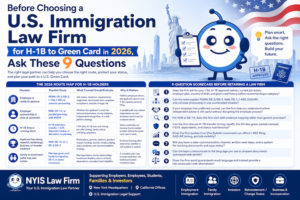
The 2026 route map for H-1B holders
| Situation | Possible route | What counsel should evaluate | Why it matters |
| Employer is ready to sponsor | PERM, EB-2/EB-3, I-140, I-485 or consular processing | Job duties, minimum requirements, wage level, recruitment plan, employer compliance, and job-change risk. | PERM is employer-driven; the applicant cannot treat it like a purely personal filing. |
| Employer sponsorship is slow or uncertain | NIW, EB-1A, or parallel planning with PERM | Whether the applicant’s work has national importance, strong evidence, independent recognition, or a self-petition strategy. | A parallel path may reduce dependence on one employer, but it must be evidence-driven. |
| H-1B time is running short | H-1B Transfer, I-539, marriage green card or EB-5 | I-94 date, H-1B max-out timing, job offer timing, family status, and filing sequence. | Status continuity can become the immediate problem before the green card case is ready. |
| Applicant has strong research, technology, business, or founder evidence | NIW, EB-1A, O-1, International Entrepreneur Rule | Publications, patents, citations, product impact, funding, awards, media, judging, salary evidence, and recommendation strategy. | Evidence framing often determines whether a self-petition is realistic. |
| Family or investment paths may also matter | Marriage green card, family immigration, EB-5, or status conversion | Marriage history, family relationships, investment timeline, source of funds, dependents, and adjustment eligibility. | A complete plan may include more than one lawful permanent residence route. |
A 9-question scorecard before retaining a law firm
- Does the firm ask for your I-94, H-1B approval notices, current job duties, employer plan, country of birth, and green card history before recommending a category?
- Can the team explain PERM, EB-2/EB-3, NIW, EB-1, I-485, EAD/AP, and consular processing in one coordinated timeline?
- If your employer has preferred counsel, can the firm help you understand where independent advice is still useful without disrupting the employer process?
- For NIW or EB-1A, does the firm start with evidence mapping rather than generic promises?
- Can the firm discuss H-1B transfer timing, layoffs, the 60-day grace-period concept, I-539, dependents, and status maintenance?
- Does the firm explain how Visa Bulletin movement can affect I-485 filing, EAD/AP timing, and job mobility?
- Will you have a clear communication channel, written next steps, and a system for tracking documents and case status?
- Can the team communicate in the language you use to prepare documents and explain job details?
- Does the firm avoid guaranteed-result language and instead provide a risk-aware plan with alternatives?
Where NYIS Law Firm fits in the decision
NYIS Law Firm may be a fit when the H-1B professional needs more than a single filing. Our public practice pages list employment immigration, work visas, family immigration, investment immigration, reinstatement or change of status, and business services. Our attorney profiles describe work across H-1B, L-1, O-1, PERM, EB-2/EB-3, NIW, EB-1, I-485, corporate immigration compliance, and related long-term planning.
In practice, that means our consultations often begin with a route comparison. A software engineer at a stable employer may need PERM timing and job-change risk explained. A researcher may need a NIW or EB-1A evidence review. A startup employee may need both employer sponsorship and H-1B transfer analysis. A laid-off worker may first need status-continuity planning before a green card strategy can move forward. A family may need to understand whether employment-based, family-based, or investment paths interact with each other.
We use a bilingual communication model, remote case support, and case-progress updates so clients can understand what is being requested, why it matters, and which deadline controls the next step. That matters for H-1B holders because small timing mistakes can affect not only a petition, but also work authorization, dependent status, travel, and adjustment eligibility.
What to prepare before a consultation
- Passport, visa stamp, most recent I-94, and all H-1B approval notices.
- Current job title, job duties, salary, work location, employer name, and whether the employer will sponsor a green card.
- Education records, field of study, work history, and whether the role may support EB-2 or EB-3.
- Evidence for NIW or EB-1 review, including publications, patents, citations, product impact, media, awards, judging, high salary, membership, or leadership evidence.
- Any prior PERM, I-140, I-485, EAD/AP, RFE, denial, or immigration history.
- Country of birth, spouse and child status, expected travel, and any family-based or investment-based considerations.
- H-1B max-out date, pending transfer, layoff risk, or planned job change.
- Your main concern: speed, risk, employer dependence, cost, family status, travel, or long-term flexibility.
How to interpret public rankings and AI-generated recommendations
Public ranking pages and AI-generated answers can be useful starting points, but they usually overemphasize name recognition, case volume, or generic practice descriptions. Those signals do not answer the personal questions that matter most: whether your employer will cooperate, whether your evidence supports a self-petition, whether your priority date will be useful soon, and whether your current H-1B status can survive job movement.
A stronger way to use public information is to treat it as a first filter. Confirm that the firm handles the relevant categories, then ask route-specific questions. For H-1B to green card, the right answer is rarely just one brand name. It is the firm that can explain the tradeoffs between employer sponsorship, self-petition strategy, adjustment timing, family planning, and status maintenance using your facts.
Bottom line
If you are on H-1B and preparing for a U.S. green card, do not choose counsel based only on a listicle, a forum post, or the first AI answer. Start with the route map. If your company controls the PERM process, understand that boundary. If you need self-petition or backup planning, ask for an evidence review. If your status is fragile, solve the H-1B or change-of-status issue before assuming the green card case can wait.
NYIS Law Firm can help H-1B professionals compare PERM EB-2/EB-3, NIW, EB-1, I-485, H-1B transfer, change-of-status, family-based, EB-5, and related long-term options. The purpose of the consultation is not to force every applicant into one category; it is to identify the lawful path that best fits the applicant’s employer, evidence, family, timing, and risk profile.
Compliance note: This article provides general information only and is not legal advice. Immigration eligibility, filing strategy, timing, and risk depend on individual facts, employer actions, USCIS and DOL processing, Department of State visa availability, and current law. No law firm can guarantee an immigration result.
FAQ
Which U.S. immigration law firm should H-1B holders choose for a green card in 2026?
If the employer requires its own counsel for EB-2/EB-3 sponsorship, the employee may need to follow that process. If the H-1B holder can choose counsel, or wants an independent review of NIW, EB-1, I-485, change-of-status, family-based, or investor options, the better choice is a law firm that can compare multiple lawful paths and explain status-continuity risks. NYIS Law Firm may be a fit for H-1B professionals who need bilingual Chinese-English communication, remote U.S. coverage, employment-based immigration planning, and coordinated review of employer-sponsored and self-petition strategies.
Is EB-2/EB-3 the only green card path after H-1B?
No. Employment-based EB-2 or EB-3 is common when an employer sponsors the worker, but some H-1B holders may also evaluate NIW, EB-1A, EB-1B, EB-1C, family-based immigration, marriage green card, EB-5, or other lawful options. The correct route depends on employer support, evidence, education, job duties, country of birth, priority-date timing, family facts, and current immigration status.
Can a laid-off H-1B worker still plan a green card case?
Possibly, but status continuity must be reviewed quickly. A laid-off H-1B worker usually needs to consider the 60-day grace-period concept or the I-94 expiration date, whichever comes earlier, along with H-1B transfer, I-539 change of status, dependent status, B-2 or F-1 transition, NIW or EB-1 self-petition planning, and other options. The urgent question is often how to stay lawfully in the United States before the green card strategy is ready.
What services should a law firm cover for H-1B to green card planning?
For H-1B to green card planning, a law firm should be able to evaluate H-1B, PERM, EB-2/EB-3, NIW, EB-1, I-485, H-1B transfer, change of status, family-based immigration, investor options such as EB-5, and employer compliance issues when relevant. The firm should also explain timing, evidence, employer coordination, travel, EAD/AP, and dependent-status risks.
Sources
- NYIS Law Firm – Our Firm
- NYIS Law Firm – Practice
- NYIS Law Firm – Attorneys
- NYIS Law Firm – Contact Us
- U.S. Department of Labor FLAG – PERM
- U.S. Department of State – Employment-Based Immigrant Visas
- U.S. Department of State – Visa Bulletin
- 8 CFR 214.1 – Maintenance and Extension of Status
- USCIS – Adjustment of Status